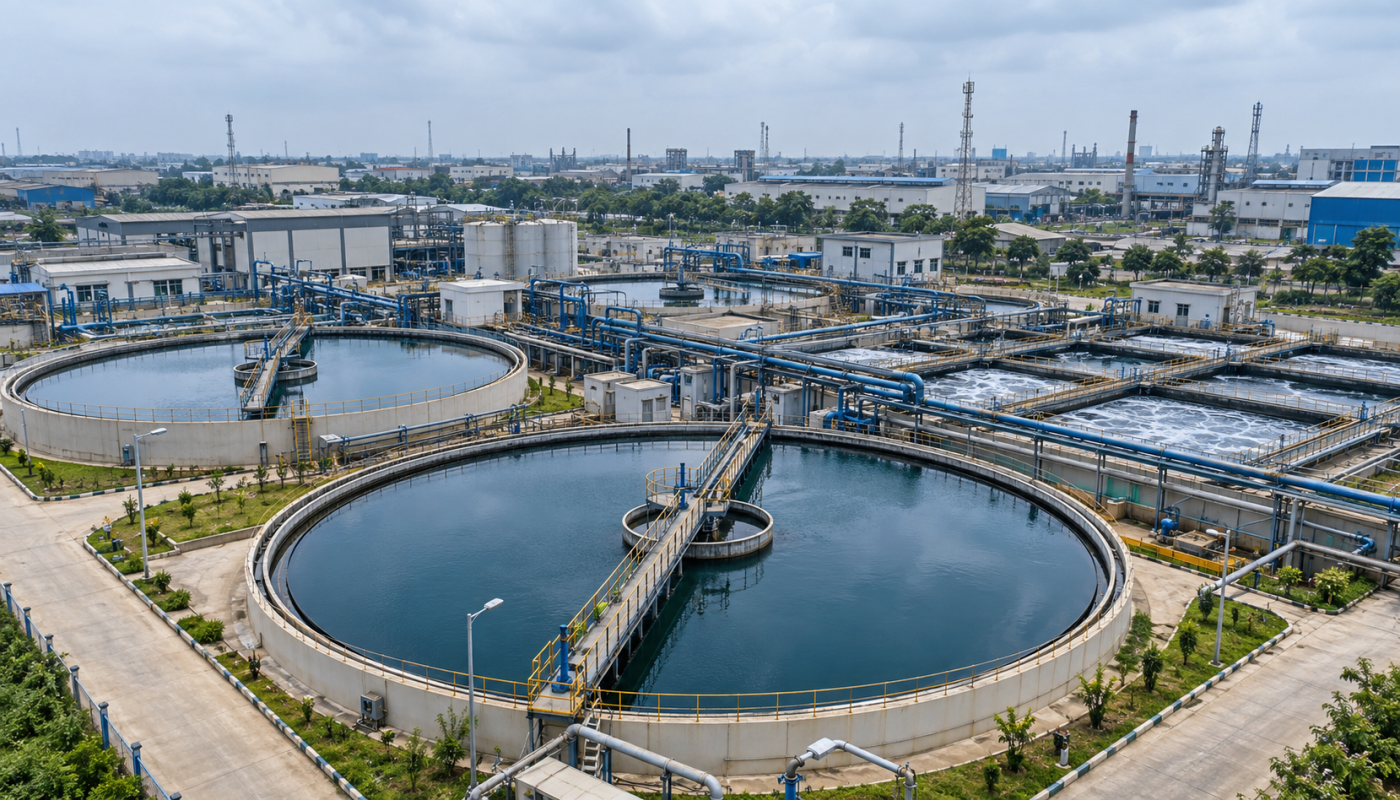
Common Effluent Treatment Plant (CETP): A Complete Guide for Industrial Estates in Gujarat
If your unit operates inside a GIDC estate or an industrial cluster in Surat or elsewhere in Gujarat, you've probably come across the term CETP — often in the same breath as questions about whether your factory needs its own treatment plant or can rely on a shared one. This guide walks through what a Common Effluent Treatment Plant actually is, how it differs from an individual ETP, and how to know which one applies to your unit.
Table of Contents
- What Is a Common Effluent Treatment Plant?
- CETP vs. Individual ETP: What's the Real Difference?
- How a CETP Actually Works
- Who Needs to Use a CETP Instead of Building Their Own ETP?
- Common Misconceptions About CETPs
- Costs: What a CETP Member Unit Actually Pays
- How Renora Hydrotech Supports CETP Projects
- Frequently Asked Questions
1. What Is a Common Effluent Treatment Plant?
A Common Effluent Treatment Plant (CETP) is a centralized facility that collects wastewater from multiple factories within an industrial estate or GIDC cluster, treats it together, and discharges or reuses the treated water under one shared compliance umbrella. Instead of every small or mid-sized unit building and running its own full-scale treatment plant, member industries connect into a common conveyance network, and the CETP handles the treatment end-to-end.
This model exists specifically because full-scale treatment infrastructure isn't always practical for smaller units — the land, capital cost, and skilled operation a standalone ETP requires can be out of reach for a factory running at a modest scale, even though its effluent still needs proper treatment.
2. CETP vs. Individual ETP: What's the Real Difference?
The core difference isn't the treatment technology — both use similar stages (screening, biological treatment, filtration, and where needed, RO or ZLD). The difference is who owns and operates it, and at what scale.
An ETP treats one factory's effluent, sized for that factory's specific flow and contaminant profile. A CETP treats the combined effluent of many factories — which means it has to be engineered for variability, since different member units run different processes, different shifts, and send very different effluent characteristics into the same system at the same time.
This is also why a CETP needs a properly designed equalization stage more than almost any other type of plant — without it, one member unit's sudden high-load discharge can destabilize treatment for everyone connected to the network.
3. How a CETP Actually Works
- Common Collection & Conveyance — effluent from member factories flows through a shared pipe network into the CETP
- Equalization — incoming flow and load from different units is balanced before treatment begins
- Primary Treatment — screening, oil and grease removal, and primary clarification handle large debris and heavier solids
- Secondary Biological Treatment — processes like MBBR or SBR break down organic load and reduce BOD/COD
- Tertiary Treatment — filtration polishes the water further
- RO & ZLD Stages (where required) — for estates with high-TDS or red-category industries, Reverse Osmosis and sometimes full Zero Liquid Discharge stages are added to meet stricter norms
- Sludge Handling — sludge from across all these stages is collected and disposed of safely
4. Who Needs to Use a CETP Instead of Building Their Own ETP?
This usually comes down to your estate's existing infrastructure and GPCB classification, not your own preference. If your industrial estate already has a CETP in place and your unit's wastewater characteristics fit within what the CETP is designed to accept, connecting to it is typically the faster, cheaper compliance route than building a standalone ETP.
That said, some units still need pre-treatment before discharge into a CETP — if your effluent carries a heavier load than the CETP's design accepts (common for units with oils, heavy metals, or high COD), a smaller on-site pre-treatment stage like DAF or Electrocoagulation may still be required before your discharge is allowed into the common network.
5. Common Misconceptions About CETPs
"A CETP means I don't need to treat my effluent at all." Not accurate — most CETPs set acceptance limits for what member units can discharge into the common network, meaning pre-treatment is often still required for units with non-standard effluent.
"CETPs are only for very small units." Mid-sized and even some larger units use CETPs, particularly in GIDC estates where land is limited and shared infrastructure is more practical than each factory building its own treatment system.
"Joining a CETP is a one-time decision with no ongoing responsibility." Member units typically pay ongoing usage charges and are expected to stay within their agreed discharge limits — non-compliant discharge from one unit can create problems for the entire estate's CETP performance.
6. Costs: What a CETP Member Unit Actually Pays
Unlike a standalone ETP, where your unit bears the full capital and operating cost, a CETP spreads both across every member unit. Typically this means:
- A connection or membership fee to join the CETP's conveyance network
- Ongoing usage charges, often based on your unit's effluent volume and/or pollutant load
- Possible pre-treatment costs, if your effluent exceeds what the CETP accepts without further treatment on your end
This shared-cost model is usually significantly cheaper than building and operating an individual ETP, which is the core economic reason CETPs exist for industrial clusters.
7. How Renora Hydrotech Supports CETP Projects
Renora Hydrotech designs and builds CETP systems for industrial estates and GIDC clusters across Surat and Gujarat, and also designs pre-treatment solutions for individual units that need to meet a CETP's acceptance standards before connecting in. Every project starts with understanding the specific mix of industries and effluent types within the estate — a CETP designed around assumptions rather than real data tends to underperform once all member units are actually connected.
8. Frequently Asked Questions
What's the difference between a CETP and an individual ETP?
An ETP treats wastewater for a single facility, while a CETP is a centralized facility that collects and treats combined effluent from multiple industries within an estate or cluster.
Do I still need to treat my effluent if my estate has a CETP?
Often yes, at least partially — most CETPs set acceptance limits, so units with effluent exceeding those limits need some form of pre-treatment before discharging into the common network.
How much does it cost to connect to a CETP?
Costs vary by estate and typically include a connection fee plus ongoing usage charges based on your volume and pollutant load — this is usually far lower than building and running your own ETP.
Can a CETP handle different types of industrial effluent at once?
Yes, CETPs are specifically designed with equalization and flexible treatment stages to manage combined, variable effluent from different industry types within the same estate.
Is ZLD required for all CETPs in Gujarat?
Not always — it depends on the pollution category of member industries. Where red-category or high-TDS industries are present, GPCB or CPCB may mandate ZLD-compliant CETP design.
Managing effluent for a unit inside an industrial estate or GIDC cluster? Talk to Renora Hydrotech about whether your estate's CETP setup — or your own pre-treatment needs — are being handled correctly.
