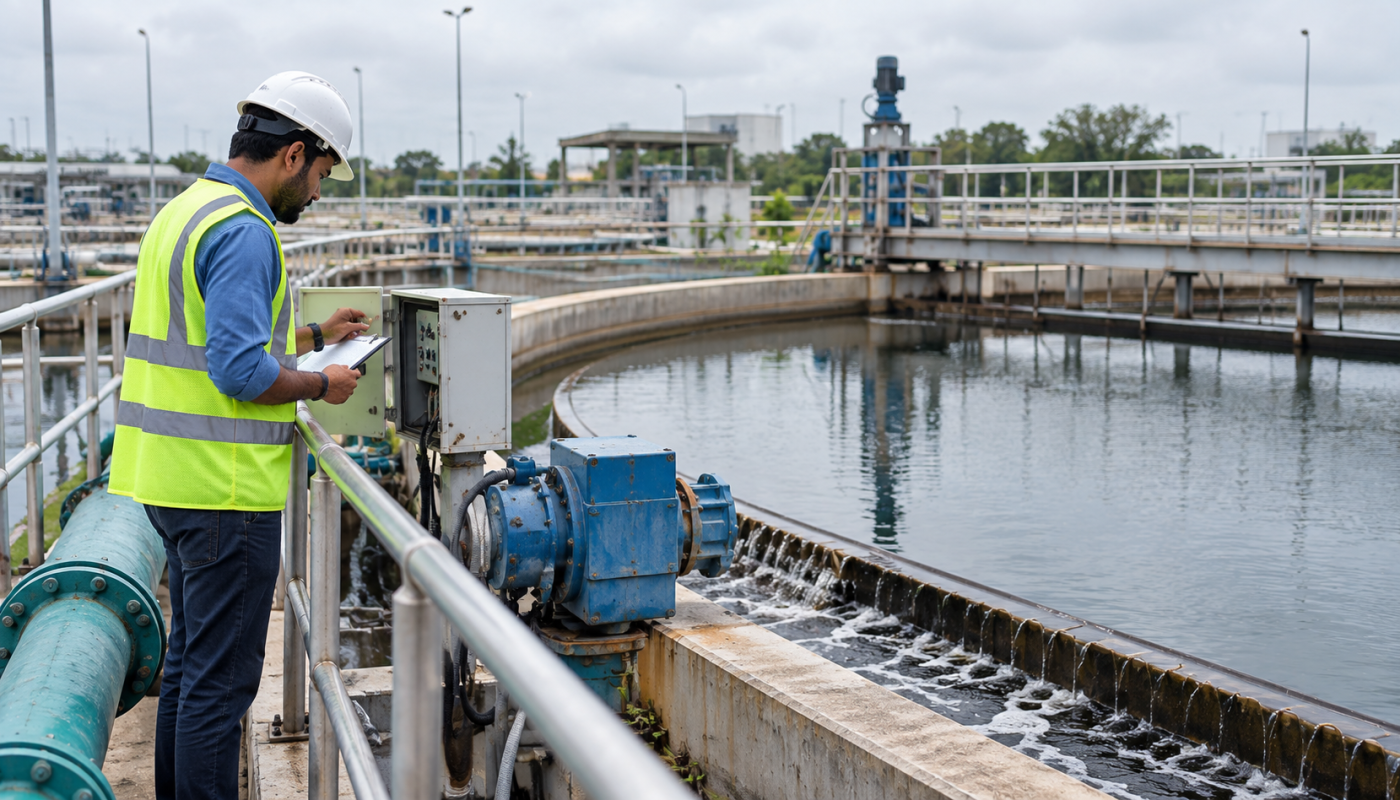
What Is a Sewage Treatment Plant? A Complete Guide to How STPs Work
Sewage Treatment Plant is one of the most searched terms in water and wastewater management — and also one of the most loosely understood. This guide covers what an STP actually does, how the treatment process works stage by stage, and the different technologies used, so you have a clear picture before evaluating a system for your own project.
Table of Contents
- What Is a Sewage Treatment Plant?
- Why Sewage Can't Just Be Discharged Untreated
- The STP Treatment Process, Stage by Stage
- Common STP Technologies: SBR, MBBR, and Extended Aeration
- Where STPs Are Used
- STP vs. ETP: A Quick Clarification
- Signs an STP Is Undersized or Underperforming
- How Renora Hydrotech Designs STP Systems
- Frequently Asked Questions
1. What Is a Sewage Treatment Plant?
A Sewage Treatment Plant (STP) is a system designed to treat domestic wastewater — the water from bathrooms, kitchens, and washing areas in homes, hotels, offices, and institutions — removing organic matter, suspended solids, and disease-causing pathogens before the water is discharged or reused. Unlike industrial wastewater, which varies enormously by process, domestic sewage has a fairly consistent composition, which is why STP technology has become fairly standardized compared to the custom engineering an ETP often requires.
2. Why Sewage Can't Just Be Discharged Untreated
Raw sewage carries high organic load (measured as BOD and COD), suspended solids, and pathogens including bacteria and viruses. Discharged untreated, it contaminates groundwater and surface water, spreads waterborne disease, and depletes dissolved oxygen in receiving water bodies, harming aquatic life. This is why treatment before discharge or reuse isn't optional — it's both an environmental necessity and, in most jurisdictions including Gujarat, a regulatory requirement enforced by pollution control boards.
3. The STP Treatment Process, Stage by Stage
Screening & Primary Treatment — Large solids and grit are removed first, followed by primary settling to separate heavier suspended matter from the wastewater stream.
Biological Treatment — This is the core of STP treatment. Microorganisms break down organic matter, consuming the pollutants that make up BOD and COD. The specific technology used here (SBR, MBBR, or Extended Aeration — covered below) is what differentiates one STP design from another.
Secondary Clarification — Treated water is separated from the biological sludge generated during treatment, in a dedicated settling stage.
Tertiary Treatment & Disinfection — Filtration removes remaining fine particles, and chlorination or UV disinfection eliminates pathogens, making the water safe for reuse in gardening, flushing, or similar non-potable applications.
Sludge Handling — Excess biological sludge produced throughout the process is periodically removed and processed for safe disposal.
4. Common STP Technologies: SBR, MBBR, and Extended Aeration
- SBR (Sequential Batch Reactor) — Treats sewage in timed batches within a single tank, giving it a compact footprint well suited to space-constrained sites.
- MBBR (Moving Bed Biofilm Reactor) — Uses floating biofilm carriers that host the microorganisms doing the biological treatment, offering stable performance with relatively low sludge generation.
- Extended Aeration — A well-established, continuous-flow technology suited to medium and large facilities with consistent, predictable flow patterns.
None of these is universally "best" — the right choice depends on available space, flow pattern, budget, and water reuse goals, which is why a proper site assessment matters more than picking a technology off a spec sheet.
5. Where STPs Are Used
- Residential colonies and housing societies
- Hotels and resorts
- Hospitals and healthcare facilities
- IT parks and commercial complexes
- Educational institutions and campuses
- Industrial facilities, for the domestic sewage component separate from their process effluent
6. STP vs. ETP: A Quick Clarification
These two terms get confused constantly, so it's worth being direct about the difference: an STP treats domestic sewage — bathroom and kitchen wastewater — while an ETP treats industrial process wastewater containing chemicals, dyes, or other process-specific contaminants. A single industrial facility often needs both — an ETP for its manufacturing effluent, and a separate STP for the sewage generated by its staff facilities.
7. Signs an STP Is Undersized or Underperforming
- Treated water has visible color, odor, or foam, suggesting incomplete treatment
- Frequent sludge buildup or overflow issues
- The system was designed for a lower occupancy than the facility now has
- Treated water fails lab testing against discharge or reuse standards
- The plant requires constant manual intervention to keep running
If more than one of these applies, it's worth getting the system assessed rather than waiting for a compliance notice to force the issue.
8. How Renora Hydrotech Designs STP Systems
Renora Hydrotech designs, installs, and maintains STP systems for residential, commercial, and institutional projects across Surat and Gujarat, selecting between SBR, MBBR, and Extended Aeration based on each site's space, budget, and water reuse goals — not a one-size-fits-all template.
9. Frequently Asked Questions
What's the difference between an STP and a septic tank?
A septic tank provides only basic settling and partial treatment, while an STP uses active biological and mechanical processes to treat sewage to a much higher, reusable standard.
Is an STP mandatory for housing societies in Gujarat?
Many regulations require STPs for housing societies above a certain unit count or built-up area, typically enforced through GPCB and local development authorities.
How much space does an STP need?
It depends on the technology — compact options like SBR and MBBR need significantly less footprint than conventional Extended Aeration systems, making them popular for space-constrained urban sites.
Can STP-treated water be reused?
Yes — properly treated STP water is commonly reused for gardening, flushing, and cooling tower makeup, reducing a facility's freshwater consumption.
Which STP technology is right for my project?
This depends on your site's available space, budget, and expected sewage flow — a proper assessment is the only reliable way to determine the right fit.
Need an STP designed for your project in Surat or Gujarat? Talk to Renora Hydrotech's team for a free load assessment.
