MBBR Technology for Sewage Treatment Plants: Full Form, Working and Benefits
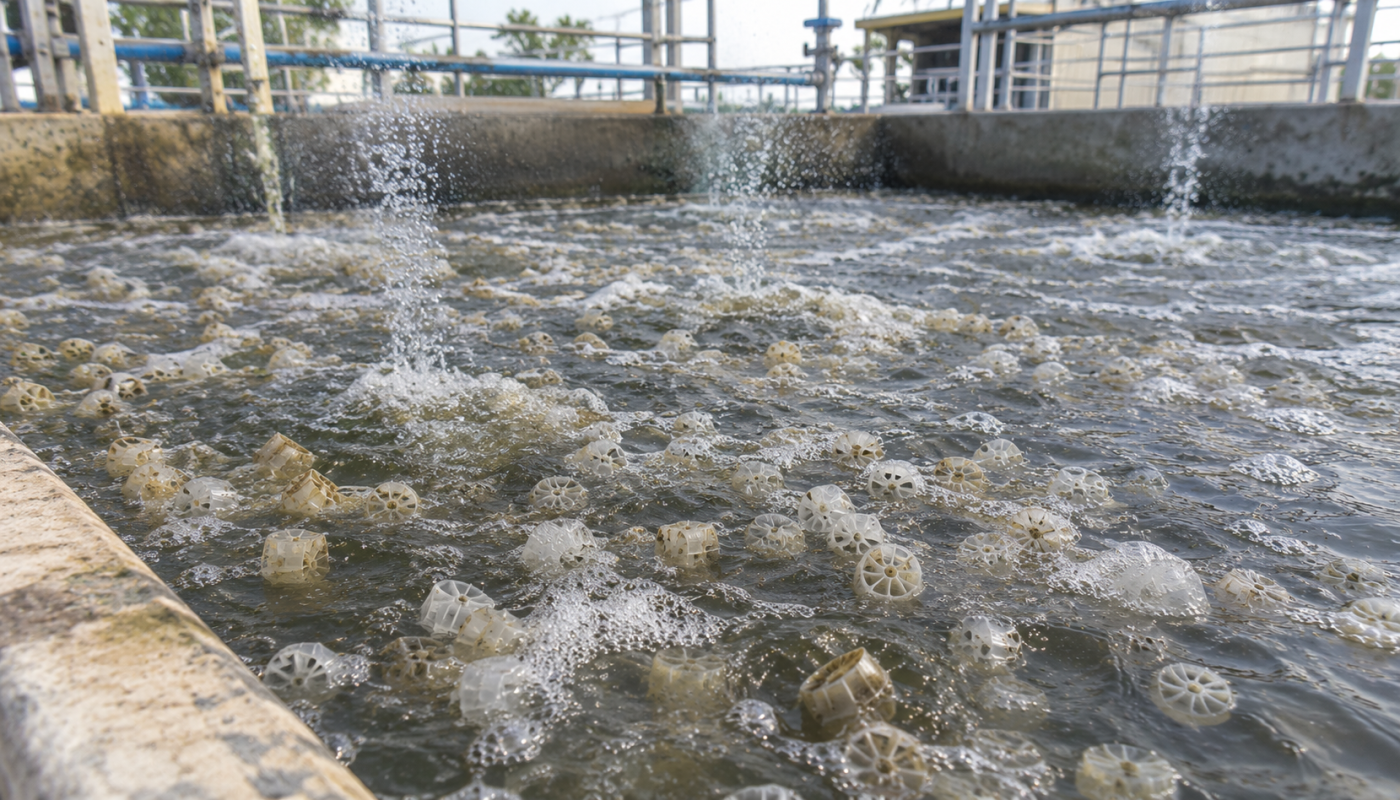
MBBR stands for Moving Bed Biofilm Reactor. It is a biological treatment technology that uses small plastic carriers, floating freely in an aeration tank, to hold the microorganisms that clean wastewater. It is widely used in sewage treatment plants (STPs) because it is compact, copes well with changes in load, and is easy to expand. This guide explains the full form, how the technology works, where it fits in an STP, and how it compares with SBR and extended aeration.
Table of Contents
- What Is MBBR? Full Form and Meaning
- How MBBR Works
- Where MBBR Fits in a Sewage Treatment Plant
- Advantages of MBBR
- Limitations to Know About
- MBBR vs. SBR vs. Extended Aeration
- Where MBBR Is Used
- What to Check Before Choosing MBBR
- Common Mistakes with MBBR Plants
- How Renora Hydrotech Designs MBBR-Based STPs
- Frequently Asked Questions
1. What Is MBBR? Full Form and Meaning
The full form of MBBR is Moving Bed Biofilm Reactor. Each word describes part of the process:
- Moving bed: small carriers move freely through the tank.
- Biofilm: a thin layer of microorganisms grows on the surface of those carriers.
- Reactor: the tank where the biological breakdown of pollutants takes place.
In an STP, those microorganisms feed on the organic matter in sewage and reduce its BOD and COD, so the water can be reused or discharged safely.
2. How MBBR Works
- Carriers. Small plastic pieces, usually with a shape that gives a large surface area, are added to the aeration tank. They are made to float and move easily in water.
- Biofilm growth. Over the first few weeks of operation, microorganisms attach to the carriers and form a biofilm, often protected inside the carrier’s channels.
- Aeration. Air is blown in from the bottom of the tank. It supplies oxygen to the microorganisms and keeps the carriers constantly moving and mixing with the sewage.
- Treatment. As sewage flows through, the biofilm absorbs and breaks down organic pollutants.
- Separation. Screens at the outlet keep the carriers inside the tank, while the treated water and loose biological matter move on to the next stage.
Unlike a conventional activated sludge plant, MBBR does not depend on recycling sludge back into the aeration tank to keep enough microorganisms in the system. The microorganisms are held on the carriers instead.
3. Where MBBR Fits in a Sewage Treatment Plant
MBBR is the biological stage, and the plant around it follows the usual order:
- Screening and grit removal: a bar screen removes rags, plastic and large solids before they reach the tank. This stage matters more than usual in MBBR plants, because debris can clog the carrier-retention screens.
- Equalization: a holding tank balances the flow and strength of the sewage.
- MBBR tank: the moving carriers and aeration described above.
- Secondary clarifier: treated water settles away from the loose biological sludge.
- Tertiary treatment and disinfection: filtration and chlorination or UV make the water safe for reuse.
- Sludge handling: excess sludge is removed and processed for safe disposal.
For a full walkthrough of these stages, see our guide to how a sewage treatment plant works.
4. Advantages of MBBR
- Compact footprint. Because the carriers hold a large amount of biomass in a small volume, the tank can be smaller than in a conventional design. That helps on urban sites with little land.
- Copes with load changes. Sewage flow varies through the day. The biofilm is less affected by these swings than a suspended-growth system.
- Lower sludge generation. MBBR plants generally produce less excess sludge than conventional activated sludge plants.
- Easy to expand. In many cases you can raise a plant’s capacity by adding more carriers to an existing tank, instead of building a new one.
- Simple operation. There’s no sludge-return loop to manage, so day-to-day running is more straightforward.
- Stable performance. The biofilm is protected on the carrier surface, so the process is generally steady.
5. Limitations to Know About
No technology suits every site, and it is better to know the trade-offs before you decide.
- It still needs good screening. Debris that gets past the inlet screen can clog the carrier-retention screens and cause problems.
- Aeration uses electricity. MBBR needs enough air to supply oxygen and keep the carriers moving, so the blower is a significant running cost.
- Start-up takes time. The biofilm needs some weeks to establish, and the plant shouldn’t be judged on its first days.
- It still needs a clarifier. MBBR replaces the biological tank, not the settling stage afterwards.
- Carriers are a upfront cost. The media adds to the initial price, although it is designed for long service life.
6. MBBR vs. SBR vs. Extended Aeration
These are the three technologies most often chosen for STPs. The right one depends on your site.
| MBBR | SBR | Extended Aeration | |
|---|---|---|---|
| How it works | Biofilm on floating carriers | Treats sewage in timed batches in one tank | Continuous aeration with suspended biomass |
| Space needed | Compact | Compact | Larger |
| Handles variable flow | Well | Well, with correct design | Best with steady flow |
| Sludge | Lower | Moderate | Higher |
| Operation | Simple, no sludge return | Needs automation and timing control | Simple and well established |
| Typically suits | Space-limited sites, variable load, upgrades | Compact sites with moderate to high flow variation | Medium to large sites with steady flow |
There isn’t one best option. Our STP vs septic tank guide also explains why a proper STP is the right choice for societies in the first place.
7. Where MBBR Is Used
- Housing societies and apartment complexes
- Hotels and resorts
- Hospitals and healthcare facilities
- IT parks and commercial complexes
- Educational institutions and campuses
- Upgrades of existing plants that have outgrown their capacity
- Industrial sites that treat effluent through an effluent treatment plant, where MBBR is one of the biological options
8. What to Check Before Choosing MBBR
- Sewage load: the number of residents or users, and the expected daily flow.
- Available space: MBBR suits tight sites, but you still need room for the clarifier, blower and other units.
- Inlet screening: make sure a suitable bar screen or fine screen is part of the design.
- Aeration capacity: the blower should supply enough air for both oxygen and carrier movement.
- Treated water target: decide whether the water will be reused, and what quality that needs, because it decides the stages after MBBR.
- Future growth: if you expect expansion, MBBR’s ability to add carriers can be a real advantage.
- Operator and service: plan for a trained operator and regular maintenance from day one.
9. Common Mistakes with MBBR Plants
- Skipping or under-sizing the inlet screen. Debris reaches the tank and blocks the outlet screens.
- Undersized aeration. If the carriers don’t move properly, parts of the biofilm are starved of oxygen.
- Rushed commissioning. The biofilm needs time, and loading the plant fully on day one slows the build-up.
- No operator training. Problems go unnoticed until residents complain about smell.
- Ignoring maintenance. Blowers and diffusers need regular servicing, as in any aerated plant.
10. How Renora Hydrotech Designs MBBR-Based STPs
Renora Hydrotech designs, installs and commissions STP systems for housing societies, hotels, hospitals and commercial projects across Surat and Gujarat. We choose between MBBR, SBR and extended aeration based on your space, budget and sewage flow, not a single standard design. Every project starts with a load assessment, and includes commissioning, operator training and maintenance support. MBBR carriers and other plant components are also available through our equipment range.
11. Frequently Asked Questions
What is the full form of MBBR?
MBBR stands for Moving Bed Biofilm Reactor.
How does MBBR work in a sewage treatment plant?
Plastic carriers float in an aerated tank. Microorganisms grow as a biofilm on the carriers and break down the organic pollutants in the sewage as the carriers move through it.
Is MBBR good for sewage treatment?
Yes. It is widely used for sewage because it is compact, handles changing loads and is easy to operate. Whether it is the best choice for your site depends on your space, flow and budget.
What is the difference between MBBR and SBR?
MBBR holds the microorganisms on floating carriers and treats sewage continuously. SBR treats sewage in timed batches within a single tank. Both are compact, and the right one depends on your site and how much automation you want.
Does MBBR need sludge recycling?
Not in the way a conventional activated sludge plant does. The microorganisms are held on the carriers, so there is no need to return sludge to the tank to keep the biomass up.
How long does an MBBR plant take to start working properly?
The biofilm needs some weeks to establish on the carriers. The plant should be commissioned and monitored through this period before you judge its performance.
Can an existing STP be upgraded with MBBR?
Often yes. Adding carriers to an existing aeration tank is a common way to raise capacity, depending on the condition and design of the plant. An assessment will show if it suits your plant.
Planning a new STP or upgrading an existing one in Surat or Gujarat? Talk to Renora Hydrotech for a free load assessment and a technology recommendation for your site.
